











What are Interchange Fees? The Hidden Engine of Payments
Every time a customer taps a credit card, a complex, high-speed negotiation happens behind the scenes. At the center of this web is the Interchange Fee: the undisputed, unnegotiable toll booth of the global banking system. Let's break down exactly what it is and why you're paying it.
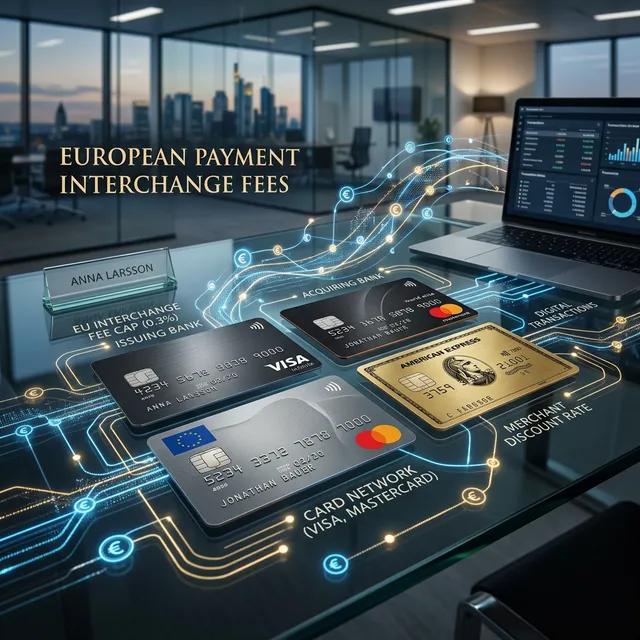
What is Interchange Fees & How do they affect your business?
Discover the meaning of Interchange Fees, who collects them, how European regulations (PSD2/MIF) cap them, and why they impact your online and POS acceptance costs.
To understand Interchange, you have to understand who's at the table when a 100€ pair of shoes is sold:
1. The Merchant (You) and your acquiring bank (e.g., RoxPay).
2. The Card Network (Visa, Mastercard) who builds the communication rails.
3. The Customer and their Issuing Bank (e.g., Monzo, Chase) who actually fronted the 100€.
The Interchange Fee is entirely collected by the Customer's Issuing Bank. Why? Because they took the risk of giving that customer a credit card, and they want to be compensated for that risk and for running the rewards program.
European Caps: Your Secret Weapon
If you are an e-commerce business selling primarily in Europe, you are incredibly lucky.
In 2015, the European Union passed the Interchange Fee Regulation (IFR), ruthlessly capping consumer card fees. If a customer from Spain buys something from your French store using a standard consumer card, Visa and Mastercard cannot legally charge you more than:
0.20% for Debit Cards.
0.30% for Credit Cards.
This is why accepting local B2C cards in Europe is wildly cheap-assuming your payment provider is actually passing these savings on to you (via IC++ pricing) rather than pocketing the difference.
When Do Interchange Fees Get Expensive?
The 0.20% EU cap sounds beautiful, but there is a massive catch. The cap does not apply to three types of cards:
1. Corporate / Business Cards: If a CEO pays you with a company Amex or Visa Business, the issuing bank can charge whatever they want (often 1.5% to 2.5%).
2. Inter-regional Cards: If an American tourist buys something on your Italian online store using their USA-issued Chase Sapphire card, the fee skyrockets (often 1.15% to 2.90%).
3. Amex / Diners: Three-party schemes are generally exempt from the EU caps.
How to Protect Your Margins
You can't negotiate Interchange Fees, but you don't have to be a victim of them either.
Know your audience: If 90% of your customers are B2B businesses paying with corporate cards, a "Blended" fixed rate (e.g., 1.9%) might actually save you money compared to IC++.
Encourage local methods: If you hate paying 2.5% on an American card, integrate Account-to-Account (Open Banking), iDEAL, or Bancontact. These local methods bypass Visa/Mastercard Interchange rails entirely, often costing just a few cents per transaction.
Perguntas frequentes
Who sets the Interchange Rates?
They are technically set and published by the card networks (Visa, Mastercard). However, the networks themselves don't keep this money; they distribute it to the Issuing banks to incentivize them to issue more cards.
Can RoxPay or Stripe lower my Interchange fee?
No processor in the world can negotiate Interchange. Any provider claiming they can is lying. A processor can only lower their own Markup (their personal profit margin on top of the Interchange).
Também pode gostar de
Gateway de pagamento de alto risco
Processamento seguro para setores de alto risco, com encaminhamento para vários adquirentes e proteção contra contestações.
Soluções de pagamento para pequenas empresas
Preços IC++ transparentes, terminal Smart POS incluído e ativação em 24 horas para pequenos negócios.
Integrações de pagamento para e-commerce
Plugins de instalação rápida para WooCommerce, Magento e PrestaShop, com acesso completo à API.
Otimize os seus pagamentos hoje
Stop guessing what your true fees are. Switch to a transparent IC++ processor to pay exactly what Visa and Mastercard mandate-not a penny more.
✓ Sem custos fixos mensais · ✓ Ativação em 24 horas · ✓ Suporte técnico dedicado